10 Trees With Purple Flowers From Compact to Canopy
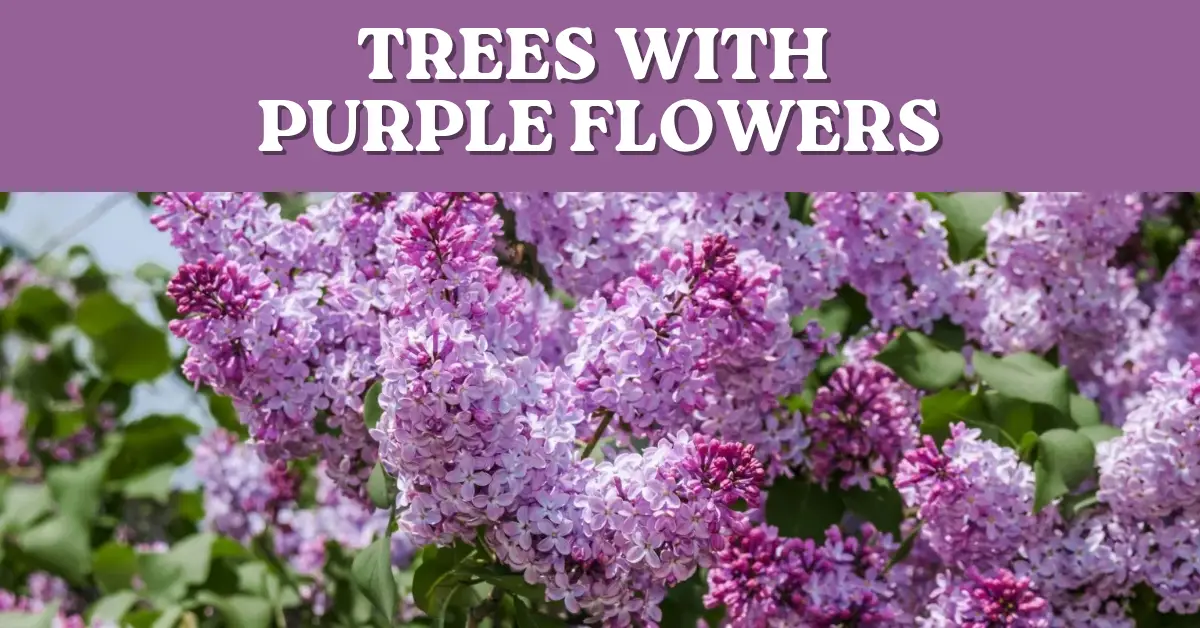
Purple is not the easiest color to find in a flowering tree, but when you do find it, it tends to be worth the search. A tree in full purple bloom has a presence that most other garden plants simply cannot match — and the options available cover a much wider range of sizes and climates than most gardeners expect.
If you are trying to add some color to your yard and want something beyond the usual pink and white, a purple flowering tree is worth thinking about. Some of these trees are grown purely for their flowers, putting on a short but spectacular display in spring or summer. Others bring purple into the picture through their foliage and keep that color going for months. A few do both.
This list covers ten of the best trees with purple flowers from compact weeping trees that work in a small courtyard to large canopy trees that can anchor an entire landscape. For each one you will find the key details: where it grows, what soil and sunlight it needs, how big it gets, and when it blooms. Whether you are actively shopping for a new tree or just exploring what is possible, there is a good chance something on this list will catch your eye.
List of Trees With Purple Flowers
- Takasago Flowering Cherry (Prunus serrulata ‘Takasago’)
- Silk Floss Tree (Ceiba speciosa)
- Royal Empress Tree (Paulownia tomentosa)
- Purple Wisteria Tree (Wisteria sinensis)
- Lavender Twist Redbud (Cercis canadensis ‘Covey’)
- Blue Jacaranda (Jacaranda mimosifolia)
- Purple Robe Locust (Robinia pseudoacacia ‘Purple Robe’)
- Texas Mountain Laurel (Sophora secundiflora)
- ‘Royal Purple’ Magnolia (Magnolia × soulangeana)
- Royal Purple Smoke Tree (Cotinus coggygria ‘Royal Purple’)
Takasago Flowering Cherry (Prunus serrulata ‘Takasago’)
Plant Basics:
- Native to: Japan
- USDA Zones: 5–8
- Soil: Well-drained loamy soil, pH 6.0–7.5
- Sunlight: Full sun (6–8 hours daily)
- Plant Height: 20–30 feet tall
- Bloom Time: Early to mid-spring; nursery plants usually bloom within 2–4 years
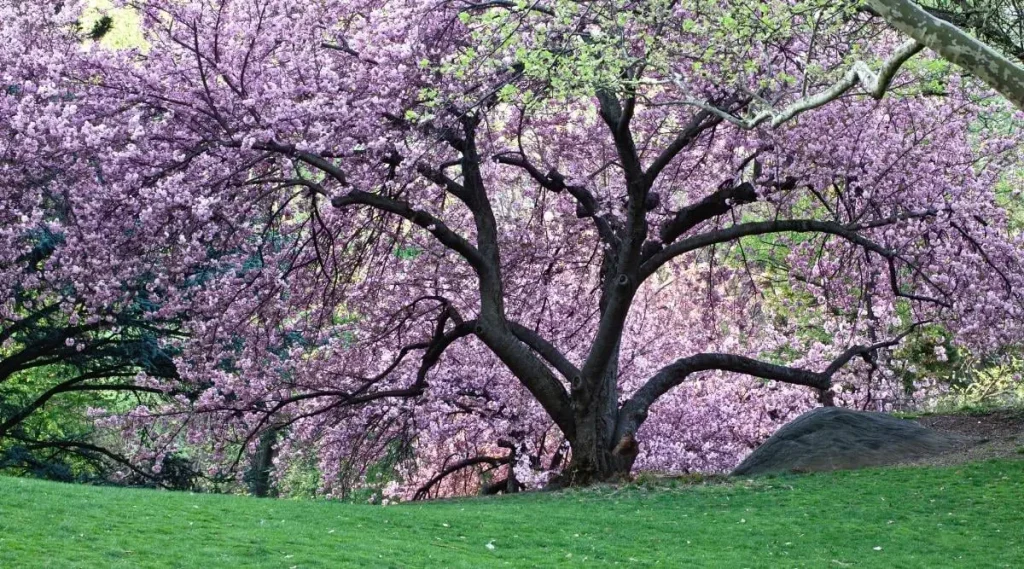
This tree is known for its light lavender blossoms that grow in clusters along the branches. The flowers appear in early spring before the leaves fully develop. Each bloom has a gentle color that look slightly deeper in cool weather.
The leaves start as bronze when young, then turn green, and finally change to yellow or orange in fall before dropping. The tree has a rounded crown and spreads evenly as it matures.
It is planted along pathways, in parks and as a single feature tree in gardens. Regular watering is required when the tree is young. Once established, it can handle short dry periods, but it grows better with consistent moisture. Pruning should be done after flowering to maintain its shape and remove weak branches.
Silk Floss Tree (Ceiba speciosa)
Plant Basics:
- Native to: South America (Brazil, Argentina)
- USDA Zones: 9–11
- Soil: Well-drained sandy or loamy soil, pH 6.0–7.5
- Sunlight: Full sun (6–8 hours daily)
- Plant Height: 30–60 feet tall
- Bloom Time: Fall season; nursery plants usually bloom in 3–5 years
The trunk of this tree stops people first. It is thick, green, and studded with heavy conical spines that serve as water storage during dry periods. Young trees have a distinctly green trunk that gradually turns gray with age. The spines remain throughout the tree’s life.
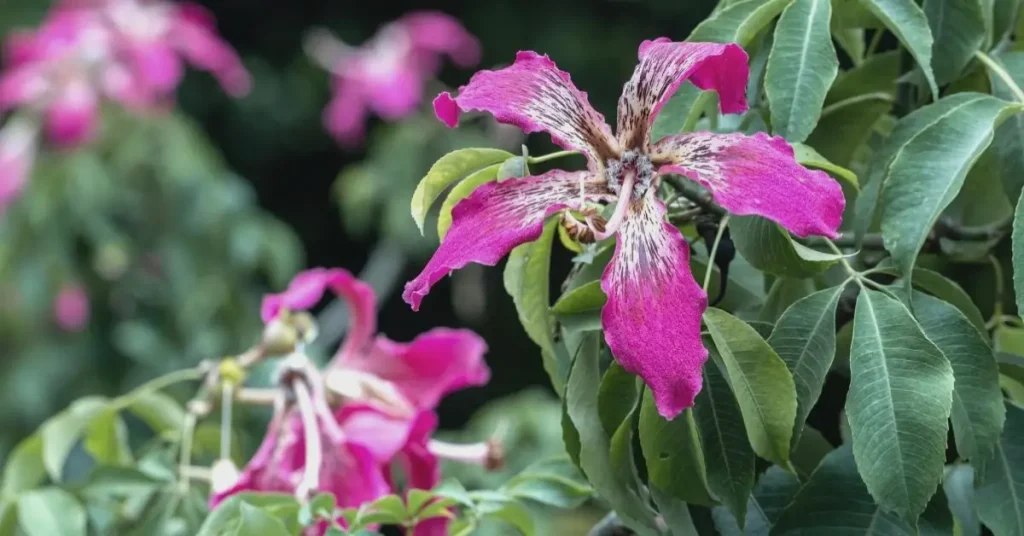
Flowers appear when the tree is largely or fully leafless. They are hibiscus-like, around 4 to 5 inches across, in shades of pink to magenta with a white and yellow center. After flowering, large pear-shaped pods develop and split open to release seeds embedded in a silky cotton-like fiber.
It is widely planted as a street and park tree across warm climates. The canopy is broad and provides reasonable shade in summer. In zones below 9, it can be grown in containers and overwintered indoors.
Royal Empress Tree (Paulownia tomentosa)
Plant Basics:
- Native to: China
- USDA Zones: 5–9
- Soil: Well-drained sandy or loamy soil, pH 5.5–7.5
- Sunlight: Full sun (6–8 hours daily)
- Plant Height: 30–50 feet tall
- Bloom Time: Early spring; nursery plants usually bloom in 3–5 years
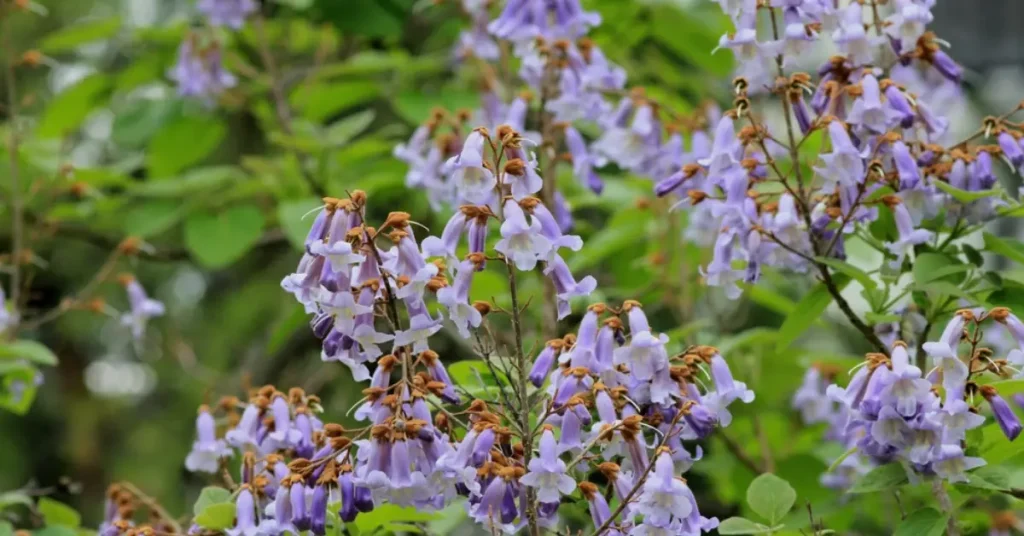
Commonly called Foxglove Tree or Princess Tree, this is one of the fastest-growing flowering trees available, putting on 10 to 15 feet of growth per year under good conditions. The flower buds form in autumn, overwinter on the branch, and open in spring before the leaves. They are tubular, violet to pale purple, and carried in large upright clusters that can reach 12 inches long. The fragrance is noticeable from a distance.
Its leaves are very large and heart-shaped. They grow quickly and can create dense shade during the growing season.
This tree is planted for shade or as a decorative tree in large spaces. It spreads easily and can grow in poor soils, but it still needs good drainage. Regular pruning helps control its size and shape.
Purple Wisteria Tree (Wisteria sinensis)
Plant Basics:
- Native to: China
- USDA Zones: 5–9
- Soil: Well-drained loamy soil, pH 6.0–7.0
- Sunlight: Full sun (6–8 hours daily)
- Plant Height: 10–25 feet tall (when trained as a tree)
- Bloom Time: Spring; nursery plants usually bloom in 3–5 years (can take longer if grown from seed)
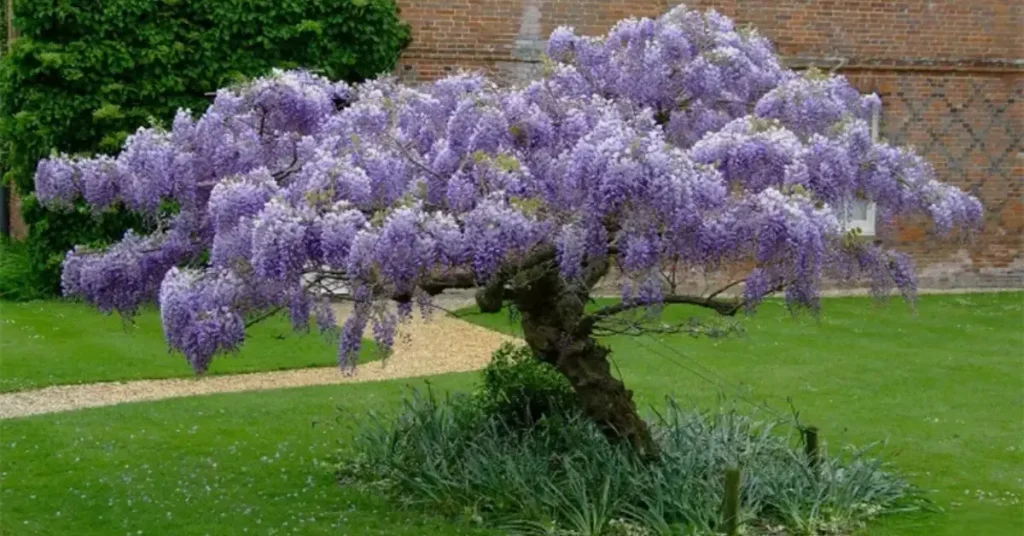
This plant is trained into a small tree form, even though it is naturally a climbing vine. It forms a short trunk with a rounded top when pruned regularly. Long clusters of purple flowers hang down from the branches, creating a curtain-like effect in spring.
The flowers are lightly fragrant and attract bees and butterflies. After blooming, green leaves fill out the canopy and provide shade through summer.
It is commonly used near patios, garden paths, or as a focal point. Strong support and regular pruning is needed to keep its tree shape. Without control, it can grow quickly and spread over nearby structures.
Read: Pink Flowering Trees
Lavender Twist Redbud (Cercis canadensis ‘Covey’)
Plant Basics:
- Native to: North America (cultivar of Eastern Redbud)
- USDA Zones: 5–9
- Soil: Well-drained loamy or sandy soil, pH 6.0–7.5
- Sunlight: Full sun to partial shade (4–8 hours daily)
- Plant Height: 8–12 feet tall
- Bloom Time: Early spring; nursery plants usually bloom in 2–3 years
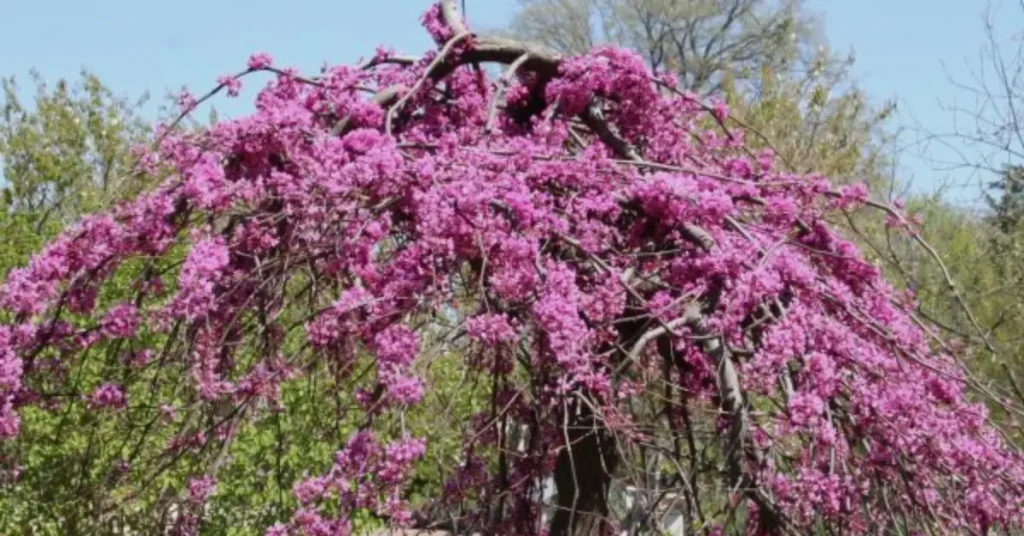
This small tree has a weeping shape, with branches that bend downward and form a rounded canopy. Flowers are small, rosy-pink to lavender-pink, and appear in dense clusters directly on the branches and older wood. They cover the tree before any foliage appears.
Its leaves are heart-shaped and turn green after the flowers fade. In fall, they change to yellow before dropping. The tree stays compact and that is why it is best flowering tree for small gardens or near walkways.
It is planted as a feature tree because of its shape. It handles clay soil better than many ornamental trees. Light pruning helps keep its form. Regular watering is needed when it is young, especially during dry periods.
Blue Jacaranda (Jacaranda mimosifolia)
Plant Basics:
- Native to: South America (Brazil, Argentina)
- USDA Zones: 9–11
- Soil: Well-drained sandy or loamy soil, pH 6.0–7.5
- Sunlight: Full sun (6–8 hours daily)
- Plant Height: 25–50 feet tall
- Bloom Time: Late spring to early summer; nursery plants usually bloom in 5–7 years
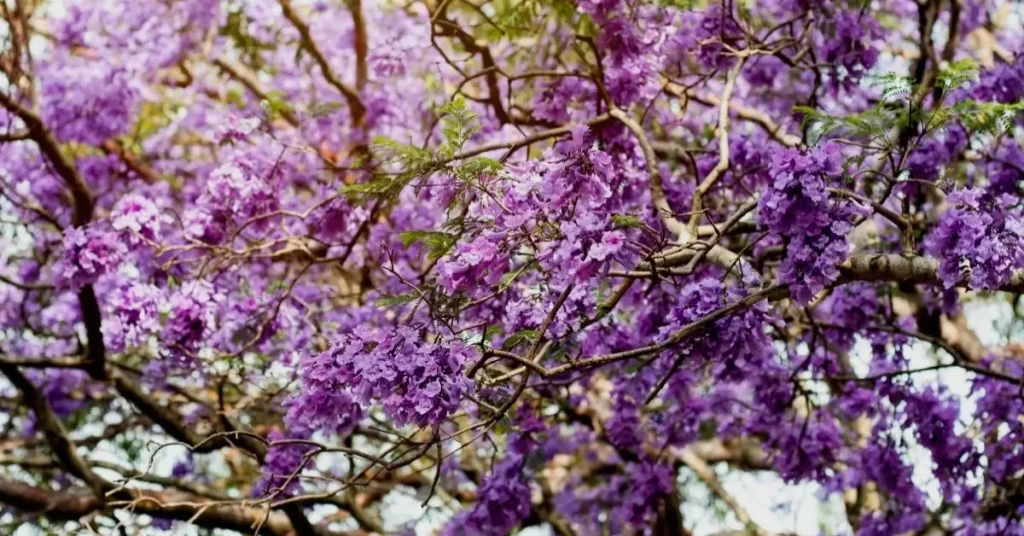
Few flowering trees produce a canopy color as distinctive as this one. The flowers are tubular, violet-blue to lavender and in large clusters across the entire canopy. When they drop, they form a purple carpet beneath the tree.
Leaves are finely divided and feathery, giving the tree a soft, airy appearance similar to a large fern. It is briefly deciduous in cooler winters but may hold its leaves year-round in frost-free climates. The canopy is broad and spreading with an irregular, somewhat flat-topped profile at maturity.
Jacaranda is widely planted across warm cities worldwide from Pretoria to Los Angeles to Sydney. Roots can be aggressive near pavement and structures. Regular watering helps young trees grow, but mature trees can handle short dry periods. In zones below 9 it can be grown in large containers but rarely reaches a size where it blooms reliably.
Purple Robe Locust (Robinia pseudoacacia ‘Purple Robe’)
Plant Basics:
- Native to: North America (cultivar of Black Locust)
- USDA Zones: 4–8
- Soil: Well-drained sandy or loamy soil, pH 6.0–8.0
- Sunlight: Full sun (6–8 hours daily)
- Plant Height: 30–50 feet tall
- Bloom Time: Late spring; nursery plants usually bloom in 3–4 years
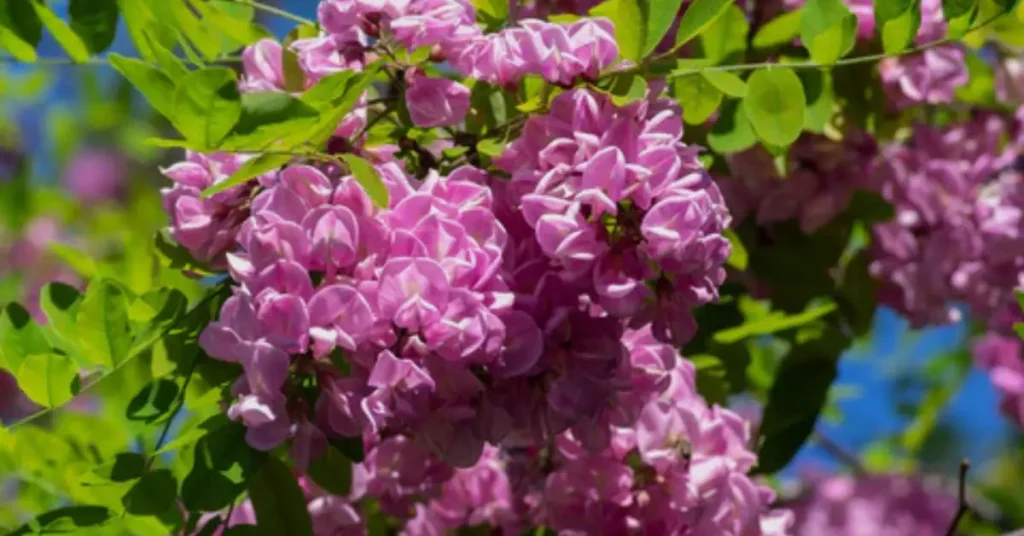
‘Purple Robe’ is a selected form of Black Locust grown for its flower color rather than the typical white of the species. The flowers are deep rose to purple-pink, pea-shaped, and carried in dense pendant clusters 4 to 8 inches long with a scent similar to wisteria. They are nectar source and draw bees heavily during bloom.
New foliage emerges in a bronzy-purple tone before settling into blue-green through summer. The canopy is upright and somewhat open, casting light shade. Branches carry paired thorns.
It is often used for shade or planted along roads and open spaces. The tree can grow in poor soil and does not need rich conditions, but it must have good drainage.
It can spread by root suckers, so some management may be needed over time. The species itself is considered invasive in parts of Europe and some regions of North America, though ‘Purple Robe’ is less aggressive than wild Black Locust.
Texas Mountain Laurel (Sophora secundiflora)
Plant Basics:
- Native to: Southern United States and northern Mexico
- USDA Zones: 7–10
- Soil: Well-drained rocky, sandy, or loamy soil, pH 6.5–8.0
- Sunlight: Full sun to partial shade (6–8 hours daily)
- Plant Height: 10–20 feet tall
- Bloom Time: Early to mid-spring; nursery plants usually bloom in 4–6 years
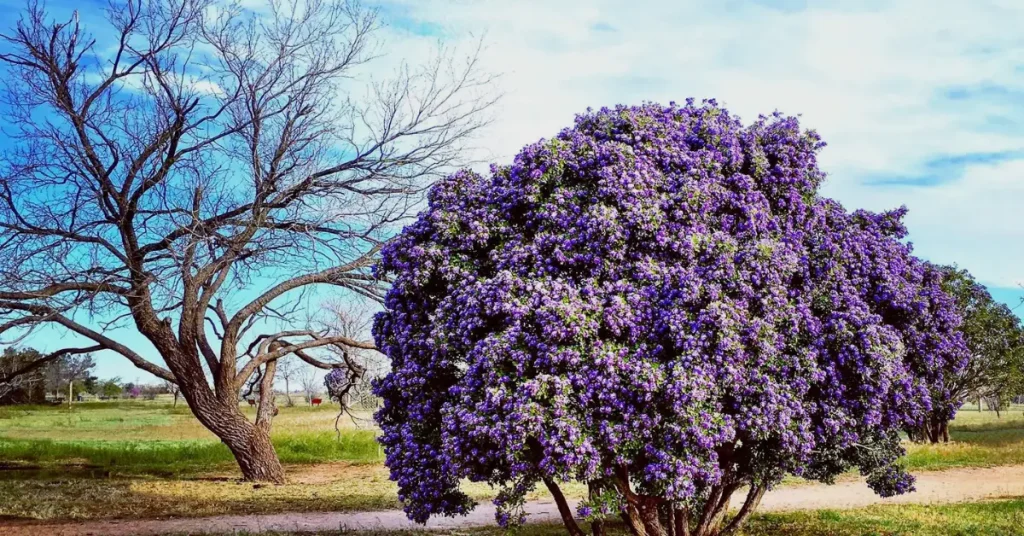
This is a slow-growing evergreen tree native to the limestone hills and rocky slopes of the Southwest, where it grows alongside oaks and junipers. The flowers are violet-purple, pea-shaped, and packed into dense upright to drooping clusters. The fragrance is famously strong and sweet, often compared to grape bubblegum, and carries a considerable distance on a warm spring day.
Leaves are glossy, dark green, and pinnate, remaining on the tree year-round and giving it a dense, refined appearance even out of bloom. After flowering, woody seed pods develop and turn red-orange at maturity. The seeds are highly toxic if ingested and should be kept in mind in gardens.
It is one of the more drought-tolerant trees on this list, thriving in the thin, alkaline soils of its native range with little supplemental water. Growth is slow, sometimes only a few inches per year, so patience is needed.
‘Royal Purple’ Magnolia (Magnolia × soulangeana)
Plant Basics:
- Native to: Hybrid origin (developed in France)
- USDA Zones: 5–9
- Soil: Well-drained loamy soil, pH 5.5–7.0
- Sunlight: Full sun to partial shade (4–8 hours daily)
- Plant Height: 20–30 feet tall
- Bloom Time: Early spring; nursery plants usually bloom in 2–4 years
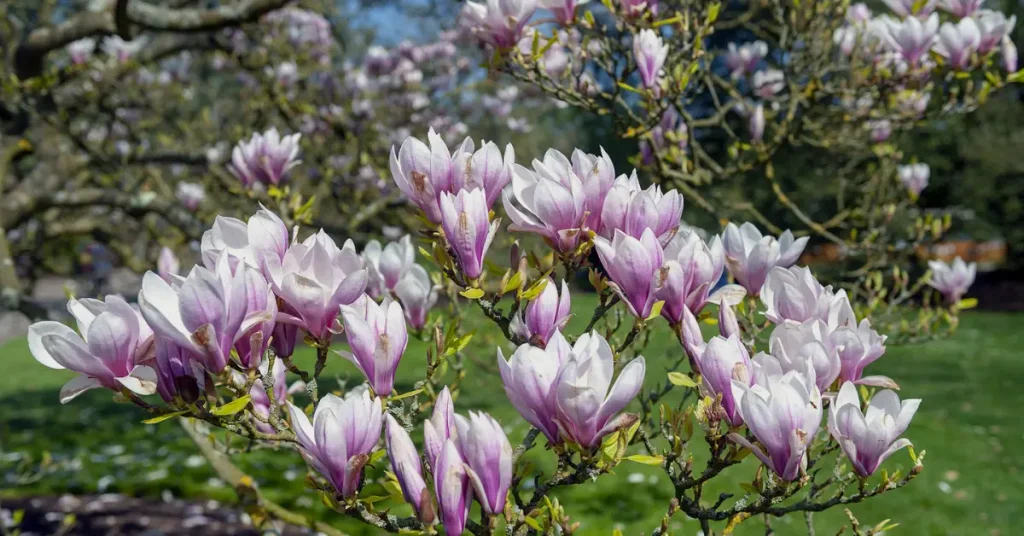
Saucer Magnolia, as it is commonly known, is one of the most widely planted ornamental trees in temperate gardens. The flowers are large, goblet-shaped, and open before the leaves, sitting upright on bare branches in a display that is hard to miss. In the ‘Royal Purple’ selection the outer petals are a deep rose-purple, fading to pale pink or near white on the inside.
Each flower can reach 5 to 10 inches across, and a mature tree in full bloom is densely covered with them. The display typically lasts one to two weeks.
It is planted in lawns or as a feature tree. Flowers can be damaged by late frost, so planting in a sheltered spot helps protect them. Regular watering is needed, especially in dry periods. Pruning is usually minimal, only to remove dead or weak branches.
Royal Purple Smoke Tree (Cotinus coggygria ‘Royal Purple’)
Plant Basics:
- Native to: Southern Europe and Central Asia (cultivar)
- USDA Zones: 5–8
- Soil: Well-drained sandy or loamy soil, pH 6.0–7.5
- Sunlight: Full sun (6–8 hours daily)
- Plant Height: 10–15 feet tall
- Bloom Time: Late spring to early summer; nursery plants usually bloom in 2–3 years
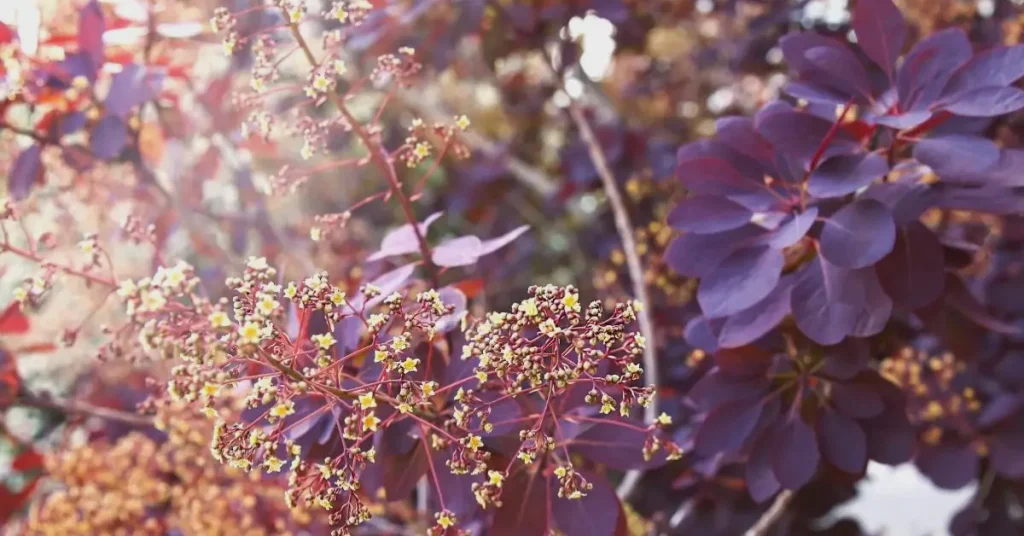
The common name comes from the flower clusters, which are made up of large plumes of tiny flowers and wispy, hair-like stalks that give the canopy a billowing, smoke-like appearance from a distance. In ‘Royal Purple’ these plumes are tinged pink to purple, sitting above the foliage in a soft, hazy mass through summer.
Foliage is the main draw for much of the year. The leaves are rounded, deep wine-red to burgundy, and hold their color through the growing season better than many purple-leaved trees. In autumn the color shifts to shades of red, orange, and scarlet before dropping, making it one of the better four-season plants on this list.
It naturally grows as a large multi-stemmed shrub but can be trained to a single trunk with early pruning. It is good to grow as a feature plant in gardens or borders. Hard pruning in late winter encourages larger, more dramatic foliage at the expense of flowers. It is tolerant of poor, dry, and rocky soils. Little maintenance is needed once established.
I hope you liked these 10 trees with purple flowers.