
How To Trim Maple Trees (Variety-Specific Pruning Tips)
Most tree guides tell you to prune in late winter, avoid over-cutting, and call a professional when it gets complicated. That advice is correct. But it leaves out everything a maple tree actually needs and why doing it wrong costs you a tree you spent years growing.
A wrong angle, a wrong season, or a wrong tool does not just slow growth. It opens doors for disease, invites structural failure, and in severe cases, kills a tree.
This guide covers everything. You will learn when to prune maple tree, how to prune, which tools to use, how to sanitize them, what diseases to look for, how to handle each major variety differently, and what to do after the pruning is done. Whether you have never held a pair of loppers or have been gardening for years, every section is written to be clear, direct and useful.
Continue reading how to trim maple trees.
Understand Maple Trees
Before you cut a single branch, you need to understand the tree you are working with. Maples are not a single species, they are a family of trees with very different growth habits, structural tendencies, and pruning needs.
Common Varieties and Their Growth Habits
| Variety | Growth Habit |
| Red Maple | Fast-growing, upright. Develops strong central leader naturally. |
| Silver Maple | Very fast. Weak wood, prone to splitting. Needs regular thinning. |
| Sugar Maple | Slow, dense, rounded crown. Minimal pruning required. |
| Japanese Maple | Slow, artistic, layered. Extremely sensitive to heavy pruning. |
| Autumn Blaze | Hybrid of red and silver. Fast growth, moderate structure. |
How Opposite Branching Works
Most maple trees have opposite branching, branches grow in pairs directly across from each other on the stem. This matters because when one branch dies or is removed, the opposite branch can become structurally dominant and pull the tree off balance. Always assess both sides of any branch you plan to cut.
Observe The Tree
Step back at least 10 feet and observe the full canopy. Identify the central leader, the dominant upward stem. Look for branches that cross each other, grow inward toward the trunk, or hang lower than the natural canopy line. Note any deadwood. A two-minute assessment before you start saves you from cuts you will regret.
When to Prune Maple Tree

Timing matters. The same cut made at the wrong time can cause sap loss, invite disease, or stress the tree.
Late Winter (The Best Time)
Late winter, just before new buds begin to swell, is the best time to prune most maple varieties. The tree is fully dormant. Sap pressure is low. There are no leaves blocking your view of the branch structure. Wounds close faster once spring growth begins, which reduces the time the cut is exposed to pathogens and insects.
In most regions, this window falls between mid-February and late March. Prune before you see any green on the buds.
Spring (Avoid Heavy Cuts)
Once spring arrives and sap begins moving, maples bleed heavily from fresh wounds. This sap loss will not kill a healthy tree, but it is unnecessary stress. Avoid pruning once buds have broken. If you have to remove a dangerous limb, do it but keep it minimal.
Summer (Light Thinning Only)
Summer pruning is doable for removing small, problematic growth: water sprouts, crossing twigs, or low-hanging branches that obstruct pathways. Avoid heavy cuts between June and August. Heat-stressed trees do not heal efficiently, and fresh wounds during hot periods attract boring insects and fungal spores.
Autumn Pruning
Autumn pruning leaves fresh wounds exposed through winter. Many fungal pathogens are active in autumn, and cold temperatures slow the tree’s ability to compartmentalize and seal cuts. The one exception is removing immediately hazardous deadwood.
Seasonal Quick Guide
| Season | Pruning Activity | Notes |
| Late Winter | Full structural pruning | Best window. Do most work here. |
| Spring | Avoid. Emergency only. | Heavy sap loss from wounds. |
| Summer | Light thinning only. | No heavy cuts. Risk of leaf scorch. |
| Autumn | Deadwood removal only. | High fungal risk. Wounds heal slowly. |
Tools For Pruning
Before you start pruning, make sure you have the right tools, like sharp pruning shears, a pruning saw, gloves, and safety goggles. For bigger branches, you may need a hand saw or a pole pruner to make clean cuts. Using the right tools helps you trim the tree properly and keep it healthy.
How to Sterilize Your Tools Between Cuts
Before you begin and between every cut on a diseased branch, wipe your blades with a solution of 70% isopropyl alcohol or a 10% bleach solution (one part bleach to nine parts water). Let the blade air dry for 30 seconds before cutting. Do not rinse. This kills fungal spores and bacterial pathogens that would otherwise transfer directly into the fresh wound.
If you are only pruning healthy wood with no sign of disease, sterilize at the start and end of each session. If you encounter any diseased material, sterilize after every single cut on that branch.
Pruning saws and loppers are worth owning for any homeowner with trees. A pole saw is worth renting unless you prune multiple large trees each season.
Identifying What to Remove
Every pruning session starts with assessment, not cutting. Walk around the trees. Look at every branch from the base to the canopy tip. Identify all problem areas before you make a single cut.
The Three Ds (Dead, Damaged, Diseased)
These are always your first priority, regardless of tree variety or time of year.
- Dead branches: No leaves in growing season, bark peeling or absent, brittle wood that snaps rather than bends. Dead branches do not recover. Remove them cleanly.
- Damaged branches: Cracks, splits, broken connections at the union. A damaged branch is a liability in any wind event. Remove to just outside the branch collar.
- Diseased branches: Discolored bark, sunken cankers, fungal growth, unusual oozing, or leaves that curl, spot, or die mid-season. Remove and do not compost and dispose of diseased material.
Common Maple Diseases to Identify
Verticillium Wilt: A soil-borne fungus that blocks the tree’s vascular system. Symptoms include sudden wilting of individual branches, yellowing or scorched leaves on one side of the tree, and a brown or green staining in the sapwood if you cut a branch cross-section. There is no cure. Remove affected branches immediately and sterilize tools thoroughly after each cut.
Tar Spot: A fungal disease that appears as black, raised tar-like spots on the upper leaf surface from mid-summer onward. It looks alarming but rarely causes serious harm. Clean up fallen leaves to reduce spore load the following year. No branch removal is typically required.
Anthracnose: A fungal infection causing brown or tan patches along leaf veins, irregular dead areas on leaves, and in severe cases, early defoliation. It thrives in cool, wet springs. Prune affected branches back to healthy wood. Improve airflow through the canopy to reduce moisture retention.
Powdery Mildew: White powdery coating on young leaves and shoots. More common on Japanese maples in humid conditions. Improve air circulation through selective thinning.
Crossing and Rubbing Branches
Branches that cross and rub against each other create open wounds on both surfaces. These wounds become entry points for disease. Identify crossing branches and remove the weaker of the two typically the one growing inward toward the trunk.
Water Sprouts and Suckers
Water sprouts are the fast-growing vertical shoots that emerge from branches, often after heavy pruning or stress. They grow quickly, produce poor structure, and drain energy from the rest of the tree. Remove them as soon as you see them.
Suckers grow from the base of the trunk or from surface roots. Remove them at the point of origin, pulling them away rather than cutting when possible. Cutting alone stimulates more sucker growth.
Step-by-Step Pruning Guide
Step 1: Check the Tree First
Look at your maple tree carefully and find any dead, broken, or unhealthy branches. Also, check the tree’s shape and balance. This helps you decide where to prune and keeps the tree healthy.
Step 2: Remove Dead or Damaged Branches
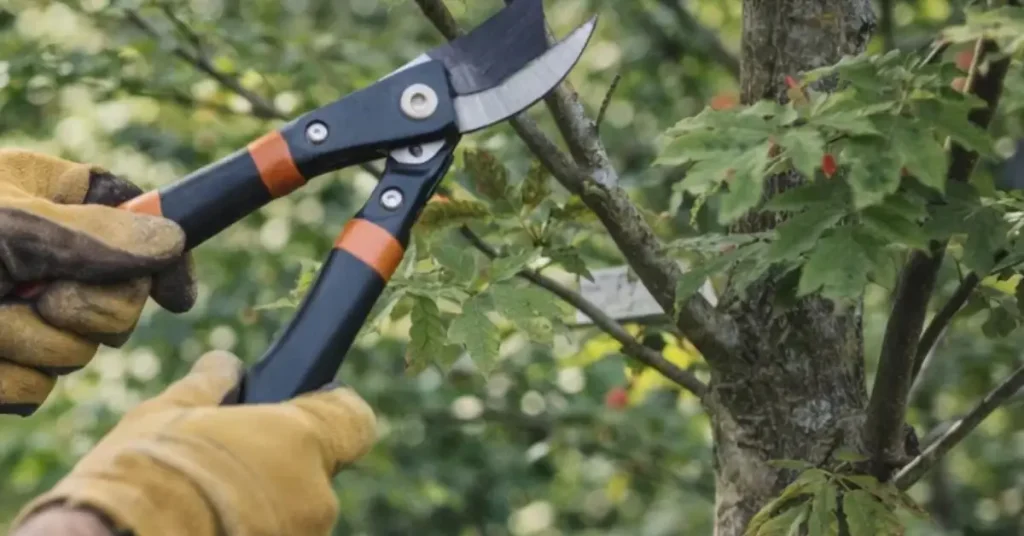
Start by cutting off dead, diseased, or broken branches. Make clean cuts near the branch collar (the swollen area where the branch joins the trunk) so the tree can heal faster. Removing these branches helps stop diseases and allows more sunlight and air into the tree.
Step 3: Thin Out Extra Branches
Remove some smaller branches to improve airflow and let more sunlight reach inside the tree. Good airflow lowers the chance of disease and supports stronger, healthier growth. Be careful to make clean cuts without damaging the tree.
Step 4: Prune Large Branches Safely
Before cutting large branches, decide if removing them is really needed. Use the three-cut method to avoid tearing the bark: make a cut underneath first, then cut from the top a little farther out, and finally remove the remaining stub. This helps the tree heal properly.
Step 5: Shape the Tree
After removing unwanted branches, trim the tree to keep a balanced and natural shape. Cut back overgrown areas so the tree looks neat. Regular shaping improves both appearance and healthy growth.
Read: 25 Monstera Pruning Mistakes
Variety-Specific Pruning Tips
Japanese Maple
Japanese maples have a naturally sculptural, layered structure that takes years to develop. Heavy pruning destroys this character in minutes and cannot be undone.
Never remove more than 10 to 15% of a Japanese maple’s canopy in one season. Focus pruning on removing dead or crossing branches and thinning the interior to allow light through the layers.
Prune Japanese maples in late winter, just like other maples, but work slowly. Step back after every few cuts. Avoid cutting the main structural branches. Work only on small, secondary growth.
Never top a Japanese maple. If the tree is too large for its space, it was planted in the wrong location. Topping will produce dense, unnatural regrowth that permanently disfigures the tree.
Red Maple
Red maples grow quickly and develop strong central leaders naturally. Your main job is supporting that structure and managing the fast growth rate. Remove competing leaders early. Thin crossing branches annually. Red maples are relatively tolerant of pruning.
Watch the branch unions closely. Red maples occasionally develop included bark (a condition where bark becomes embedded in a branch union, creating a structurally weak point that splits under load). Any V-shaped union with bark visible inside the angle should be assessed carefully and, if high-risk, removed.
Silver Maple
Silver maples grow faster than almost any other maple variety. They also have weaker wood. Without regular pruning, silver maples develop overcrowded canopies with thin, brittle branches that fail in wind and ice storms.
Prune silver maples more frequently than other varieties, every one to two years rather than every three to five. Focus on removing narrow branch unions, thinning the crown, and removing any deadwood promptly.
Sugar Maple
Sugar maples grow slowly and develop dense, rounded crowns that rarely need heavy pruning. They are also the most sensitive to pruning-related sap loss. Stick strictly to the late-winter window before any sap movement begins.
Sugar maples in commercial sap production should be pruned with even more caution. Removing large branches reduces the tapping surface area and can affect production for several seasons. Limit pruning to deadwood and essential structural corrections.
Autumn Blaze
Autumn Blaze is a hybrid of red and silver maple. Prune it more like a silver maple, frequently and with attention to branch union quality. It is susceptible to included bark and develops narrow unions more often than pure red maple.
Aftercare (What to Do Post-Pruning)
Pruning is a wound. The tree will respond. Your job after cutting is to support that response and watch for signs of stress or infection.
Wound Sealants
The older practice of painting pruning wounds with tar-based sealants is now largely discouraged by arborists. Research shows that sealants often trap moisture inside the wound rather than preventing it, which accelerates internal rot. In most cases, a clean cut made just outside the branch collar will seal on its own more effectively than any product you apply.
The one exception is elm trees pruned in beetle season, where sealants reduce insect entry. For maples, skip the sealant. A clean, correct cut is the best wound treatment available.
Watering After Pruning
Pruning temporarily reduces a tree’s ability to process water. In the weeks following late-winter pruning, as the tree enters spring growth, ensure the root zone receives adequate moisture. This matters most in regions with dry springs or where the tree is already in sandy, fast-draining soil.
Water slowly and deeply at the drip line rather than at the trunk base. Give one inch of water per week through spring if rainfall is insufficient.
Fertilization for Recovery
If your tree is in poor soil, a balanced slow-release fertilizer applied in early spring can support new growth.
Avoid high-nitrogen fertilizers immediately after heavy pruning. Excessive nitrogen stimulates rapid, soft growth that is more susceptible to disease and aphid damage.
Common Mistakes to Avoid
Topping: Cutting the top off a maple or any other large branch at an arbitrary point with no branch collar present. This leaves a large, flat wound that cannot seal properly. The tree responds with dense, weak water sprout growth from below the cut. The result is an unsafe, permanently disfigured tree. Never top a maple under any circumstances.
Flush Cuts: Cutting a branch flush with the trunk, removing the branch collar entirely. This destroys the tree’s wound-response tissue and leaves a large, flat wound directly on the trunk that cannot seal. Always cut just outside the collar.
Pruning at the Wrong Time: Heavy pruning in late spring triggers significant sap loss. Pruning in autumn exposes wounds through winter when fungal pathogens are active. Stick to the late-winter window for any significant work.
Dirty Tools: Carrying fungal spores or bacterial pathogens from one cut to another or from tree to tree on unsterilized blades.
Over-Pruning in One Season: Removing more than 25% of the canopy triggers a stress response. The tree redirects energy to produce water sprouts rather than structural growth, weakening overall form and increasing disease vulnerability.
Long Stubs: Leaving a stub of branch beyond the collar. The stub dies back, and the collar cannot reach it to seal. The dead stub becomes an entry point for rot that can travel back into the main trunk.
When to Call a Professional Arborist
Some pruning jobs are genuinely beyond what a homeowner should attempt.
Call a certified arborist when any of the following apply:
- The branch is more than 20 feet off the ground and requires a ladder or climbing equipment
- A chainsaw is needed to complete the cut
- The work is within 10 feet of a power line, this is a utility company and licensed arborist job, not a DIY task
- The tree shows signs of significant structural failure, large cracks at the trunk, major deadwood throughout the canopy, or a visible lean that was not always present
- You suspect Verticillium wilt or another systemic disease and need a professional diagnosis before deciding how much to remove
When hiring an arborist, look for ISA (International Society of Arboriculture) certification. Ask for proof of insurance. Get at least two quotes for any job over a few hundred dollars.
Frequently Asked Questions
When is the best time to prune maple trees?
Late winter, before buds begin to swell. This is when sap pressure is lowest, the tree is fully dormant, and the branch structure is visible without leaves. In most regions this falls between mid-February and late March.
Why do maple trees bleed sap when pruned?
Maples build up positive root pressure in early spring that pushes sap upward through the vascular system. When a branch is cut during this period, the pressurized sap flows from the wound. It looks alarming but does not harm a healthy tree. The simplest solution is to prune before this pressure builds, in late winter before bud break.
Can I prune a maple tree in summer?
Yes, but only lightly. Remove water sprouts, small crossing twigs, and minor deadwood. Avoid removing large branches in summer.
How do I know if my maple has Verticillium wilt?
Look for sudden wilting on individual branches, leaves that turn yellow or scorch on one side of the tree only, and branches that die back despite the rest of the tree appearing healthy. To confirm, cut a branch cross-section and look for olive-green or brown staining in the sapwood ring. If you see this, contact an arborist, there is no cure, only management through affected branch removal.
How often should I prune my maple tree?
Young trees benefit from light annual pruning during the structural training years. Mature, healthy maples typically need significant pruning every three to five years, with light deadwood removal annually. Silver maples, due to their fast growth and weak wood, benefit from pruning every one to two years.