20 Witch Garden Plants For a Mystical Outdoor Space
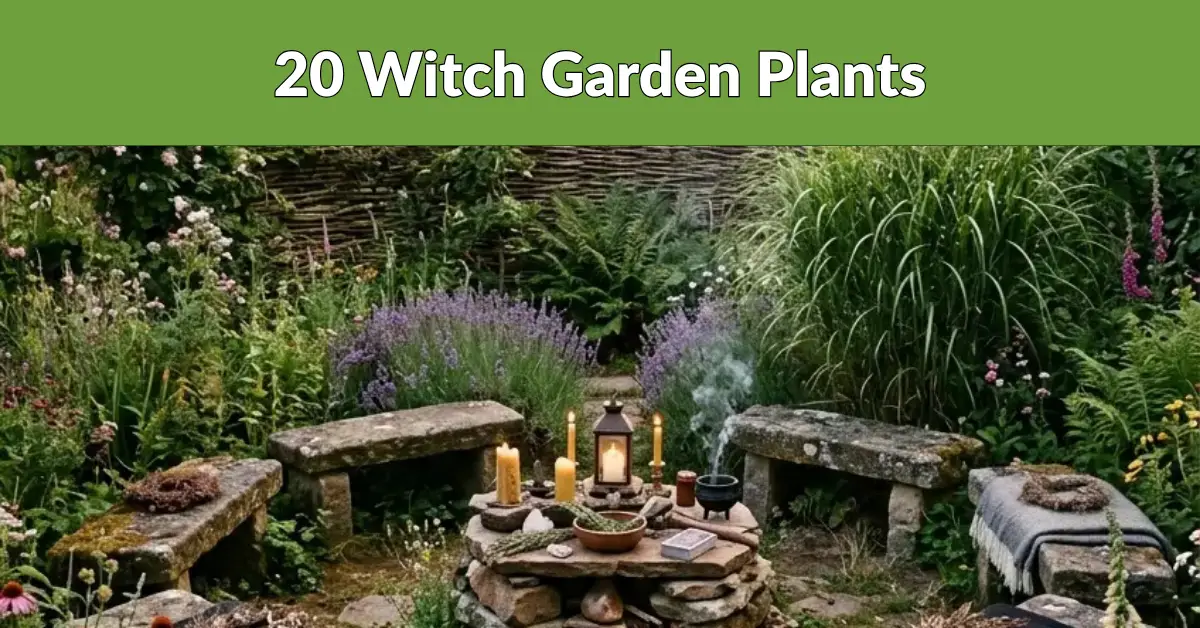
Witch garden isn’t a typical flower bed or vegetable patch. A witch’s garden is intentional, symbolic, and deeply personal. Every plant chosen with purpose, every stone placed with meaning, every pathway designed to lead you deeper into the magical world.
For centuries, witches, healers, herbalists, and wise women kept gardens that were more than just pretty, they were their pharmacies, their spell books, their altars, and their teachers. From the cunning folk of medieval Europe to the root workers of the American South, tending a magical garden has always been one of the most grounded and powerful spiritual practices. Today, that tradition is very much alive and growing stronger with every person who decides to plant something with intention rather than just habit.
If you are interested to design witchy yard, this guide will walk you through 20 witch garden plants.
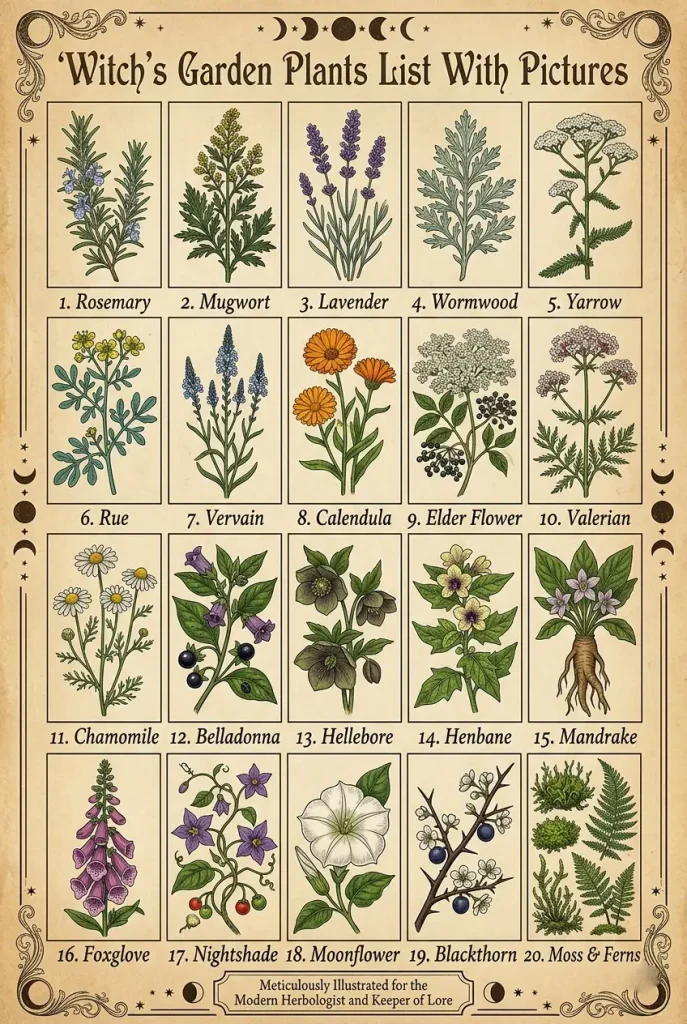
Witch’s Garden Plants List With Pictures
Here are the magical plants that we’ll be covering in detail throughout this guide, your complete witchy plant roster:
Rosemary (Rosmarinus officinalis)
Rosemary is arguably the most versatile and powerful herb in any witch’s garden. Its sharp, piney scent alone is enough to clear a room of stagnant energy. Historically, rosemary was burned at funerals to honor the dead, carried at weddings for fidelity, and hung above doorways to keep evil out. In folk magic traditions across Europe and the Mediterranean, it was considered a plant of powerful feminine energy, so potent that it was said “where rosemary grows strong, the woman rules the home.”
Magical Uses: Protection, purification, memory, love, healing, banishing negativity Growing Tips: Loves full sun and well-drained soil, thrives in dry, rocky conditions. Hardy and forgiving, perfect for beginner witches. Fun Folklore: Placing rosemary under your pillow is said to ward off nightmares and invite prophetic dreams.
Mugwort (Artemisia Vulgaris)
Named after the goddess Artemis herself, mugwort is the undisputed queen of the witch’s herb garden. This is the plant witches reach for when they want to sharpen their psychic senses, enhance dream work, or deepen meditation. It has been used for thousands of years across Celtic, Norse, Chinese and Native American traditions, a truly global magical herb. Burning dried mugwort as a smudge or placing it beneath your pillow before sleep is said to unlock vivid, prophetic dreams and astral travel.
Magical Uses: Psychic enhancement, lucid dreaming, divination, moon magic, astral projection Growing Tips: A vigorous, wild grower, give it space or it will take over. Loves moist soil and partial shade. Very low maintenance. Fun Folklore: Ancient travelers stuffed mugwort into their shoes to prevent fatigue on long journeys.
Lavender (Lavandula Angustifolia)
Lavender is the gentle, luminous heart of any witch’s garden. Its soft purple spikes and intoxicating scent have made it beloved across cultures for over 2,500 years. The Romans used it to scent their baths, the very name comes from the Latin lavare, meaning to wash. But beyond its beauty, lavender carries deep magical weight. It sits at a beautiful crossroads of healing, love, and psychic clarity, calming the mind just enough to let intuition flow freely and openly.
Magical Uses: Calm, love spells, psychic opening, sleep magic, purification, peace Growing Tips: Thrives in full sun with sandy, well-drained soil. Drought-tolerant once established. Perfect for borders and garden edges. Fun Folklore: Tucking lavender sachets into clothing drawers was said to attract love and keep the heart light.
Wormwood (Artemisia Absinthium)
Dark, bitter, and powerfully aromatic, wormwood is not a plant for the faint of heart. This is the herb of banishing, binding, and psychic protection, with a history stretching back to ancient Egypt where it was used in sacred rituals and medicine. It is perhaps most famously known as the key ingredient in absinthe, the notorious green spirit beloved by 19th-century artists and bohemians who swore it unlocked creative visions. In magical practice, wormwood is used to cut ties, break hexes, and open the veil between the living and the dead.
Magical Uses: Banishing, psychic protection, ancestral communication, breaking hexes, divination Growing Tips: Extremely hardy and drought-resistant. Grows well in poor soil and full sun. Its silvery foliage adds striking contrast in the garden. Fun Folklore: Wormwood was burned at Samhain to call upon and communicate with ancestral spirits.
Yarrow (Achillea Millefolium)
Yarrow carries one of the most heroic origin stories in all of herbal lore. Named after the Greek hero Achilles, who used it to staunch the bleeding wounds of his soldiers on the battlefield, yarrow has been a plant of healing and courage for millennia. But its magical reputation goes even deeper, yarrow is one of the oldest known divination herbs, used in the casting of the I Ching in China for over 3,000 years. Its delicate, feathery leaves and flat-topped flower clusters make it as beautiful as it is powerful.
Magical Uses: Divination, courage, love magic, wound healing, psychic protection, omen reading Growing Tips: Incredibly tough and adaptable, grows in almost any soil, full sun preferred. Spreads readily so give it room to roam. Fun Folklore: A young woman who placed yarrow under her pillow would supposedly dream of her future husband.
Rue (Ruta Graveolens)
Rue is one of the oldest and most revered protective herbs in the entire history of witchcraft and folk magic. Known across cultures as the “herb of grace,” rue has been used from ancient Rome all the way through Renaissance Europe to ward off evil, break curses, and cleanse spaces of negative energy. It carries a sharp, intensely bitter scent that feels almost medicinal. In Italian folk magic, rue is perhaps the single most important herb for protection against the evil eye, and small rue charms called cimaruta were worn as powerful talismans.
Magical Uses: Protection, curse-breaking, evil eye defense, purification, mental clarity Growing Tips: Loves full sun and dry, well-drained soil. Hardy and low-maintenance. Note: rue can cause skin irritation in some people, so handle with gloves. Fun Folklore: Shakespeare himself referenced rue in Hamlet, Ophelia hands it out saying “there’s rue for you” — connecting it to sorrow, repentance, and bitter truths.
Vervain (Verbena Officinalis)
This delicate, unassuming little plant with tiny purple flowers was considered so sacred that it could only be harvested under very specific celestial conditions, at night, during the rising of Sirius the dog star, with offerings left in its place. The Romans called it herba sacra, the sacred herb and used it in their most important religious ceremonies. Vervain sits at the intersection of spiritual power and earthly magic, amplifying spells, consecrating tools, and opening pathways to deeper wisdom.
Magical Uses: Amplifying spells, consecration, druidic magic, protection, love, purification Growing Tips: Prefers full sun to partial shade with moderately fertile, well-drained soil. Fun Folklore: Vervain was said to have sprung from the tears of Isis as she wept over the body of Osiris, connecting it to resurrection and divine grief.
Calendula (Calendula officinalis)
Bright, golden and radiant as the sun itself, calendula is the warm, joyful heart of the sacred herb garden. Also known as pot marigold, calendula has been cultivated for magical and medicinal purposes for over a thousand years across Europe, India, and the Mediterranean.
Its cheerful orange and yellow blooms track the movement of the sun across the sky, opening in the morning and closing at dusk, earning it the nickname “the sun’s bride.” In magical traditions, calendula is deeply tied to solar energy, abundance, and the realm of the dead, a fascinating duality that makes it endlessly rich.
Magical Uses: Healing, solar magic, abundance, prophetic dreams, honoring the dead, protection Growing Tips: One of the easiest herbs to grow, direct sow seeds in spring, full sun, average soil. Self-seeds prolifically so it returns year after year. Fun Folklore: Rubbing calendula petals on the skin was said to allow you to see fairies and understand the language of birds.
Elder Flower (Sambucus Nigra)
Few plants in European magical tradition carry as much weight, reverence, and mystery as the elder. In Celtic and Norse folklore, the elder was believed to be inhabited by a powerful spirit, the Elder Mother, who had to be asked permission before any part of the tree was cut or harvested. To do otherwise was to invite catastrophe. Every part of this tree, flowers, berries, bark, and leaves holds both powerful medicine and deep magic, making it one of the most complete and complex plants in the entire witch’s garden.
Magical Uses: Fairy magic, protection, healing, blessing, ancestral work, transformation Growing Tips: Grows as a large shrub or small tree. Prefers moist, fertile soil and full to partial sun. Extremely rewarding once established. Fun Folklore: Sleeping beneath an elder tree on Midsummer’s Eve was said to allow you to see the fairy realm and the Wild Hunt riding across the sky.
Valerian (Valeriana officinalis)
Valerian is the shadow herb. Its tall, graceful stems topped with clusters of tiny pink and white flowers look almost innocent, but valerian roots carry a famously pungent, earthy smell that has earned it the nickname “nature’s valium.”
Cats are notoriously drawn to it, some say even more than catnip. In magical practice, valerian occupies fascinating dual territory, it is used in both love magic and protection work, calming anxious energy while simultaneously drawing people and spirits closer.
Magical Uses: Sleep magic, love spells, protection, calming energy, harmony, purification Growing Tips: Loves full sun to partial shade with moist, well-drained soil. Tall grower, place it at the back of garden beds. Divide clumps every few years. Fun Folklore: During the Middle Ages, valerian was tucked into clothing as a perfume and love charm, its strange, musky scent was considered deeply attractive and alluring.
Chamomile (Matricaria Chamomilla)
Chamomile is the gentle giant of the witch’s garden, small in stature but enormous in magical reputation. Those tiny, cheerful daisy-like flowers with their bright yellow centers have been treasured across Egyptian, Roman, and Anglo-Saxon traditions for thousands of years.
The Egyptians considered chamomile so sacred they dedicated it to their sun god Ra, using it in embalming rituals and royal offerings. Yet chamomile carries a wonderfully approachable energy, warm, golden, and deeply comforting like sunlight bottled into a flower. It is the herb you reach for when you need gentle but persistent magic that works quietly and steadily over time.
Magical Uses: Luck, money drawing, sleep magic, love, purification, solar energy, calming hexes Growing Tips: Chamomile is easy to grow, direct sow in spring, full sun, average well-drained soil. Self-seeds freely and returns reliably every year. Fun Folklore: Washing your hands in chamomile water before gambling or playing cards was said to dramatically improve your luck and draw winnings toward you.
Belladonna (Atropa Belladonna)
Also known as deadly nightshade, this darkly beautiful plant with its glossy black berries and deep purple bell-shaped flowers is one of the most toxic plants in the natural world. Its name tells a story, bella donna means “beautiful woman” in Italian, because Renaissance women used diluted drops in their eyes to make their pupils large and luminous, considered the height of beauty at the time. In witchcraft, belladonna is deeply tied to the underworld, transformation, and the wild, untamed face of magic.
Magical Uses: Underworld journeys, transformation, astral projection, vision work, shadow magic Growing Tips: Grow with extreme caution, every part of this plant is highly toxic. Keep away from children and pets entirely. Best grown in a dedicated, fenced area of the garden. Fun Folklore: Belladonna was a key ingredient in the legendary “flying ointment”, the magical salve that witches of the Middle Ages were said to rub on their skin before riding broomsticks through the night sky.
Hellebore (Helleborus Niger)
Hellebore is the dark jewel of the winter garden, blooming stubbornly through frost and snow when everything else has died back, its deep, nodding flowers in shades of near-black, deep purple, and smoky burgundy feel almost impossibly dramatic.
Also called the Christmas Rose or Black Hellebore, this plant has been associated with magic, madness, and mystery since ancient Greece, where it was used to treat mental illness and was said to have driven entire armies to madness during the Siege of Kirrha. In the witch’s garden, hellebore represents the beauty that survives darkness — strength through the most difficult seasons.
Magical Uses: Banishing, invisibility magic, protection, shadow work, winter rituals, crossing thresholds Growing Tips: Thrives in partial to full shade with rich, moist, well-drained soil. Slow to establish but extremely long-lived, a hellebore planted today may outlive you. Fun Folklore: In medieval Europe, hellebore was scattered on the floor of a home to banish evil spirits and protect the household through the dark winter months.
Henbane (Hyoscyamus Niger)
Henbane is the wild, untamed outlaw of the witch’s herb garden, ancient, dangerous, and dripping with folklore so rich it could fill entire volumes. This sticky, hairy, intensely aromatic plant has been found in archaeological sites dating back over 3,000 years, discovered in the pouches of ancient shamans and wise women buried with their tools of the trade.
It carries an unmistakably dark energy associated with necromancy, prophecy, and the thinning of the veil between the living and the dead. Henbane was burned in temples of Apollo at Delphi, where its fumes may have contributed to the famous prophetic trances of the Oracle.
Magical Uses: Necromancy, prophetic visions, ancestral communication, trance work, rain magic Growing Tips: Toxic, handle with gloves at all times. Grows as an annual or biennial in well-drained, alkaline soil with full sun. Best grown by experienced gardeners with dedicated safety practices. Fun Folklore: Henbane seeds thrown onto hot coals were said to produce visions of the dead and allow communication with those who had passed beyond the veil.
Mandrake (Mandragora officinarum)
The single most mythologized, romanticized and feared plant in the entire history of witchcraft. Its gnarled, forked root uncannily resembles the human form with limbs, a torso, even a rough suggestion of a face and this strange resemblance gave rise to centuries of extraordinary folklore.
According to ancient legend, mandrake roots screamed when pulled from the earth, a sound so terrible it could kill anyone who heard it. Ancient herbalists reportedly tied the root to a dog and used the animal to pull it free, sacrificing the dog to the deadly shriek. Every major magical tradition from ancient Mesopotamia through Renaissance Europe considered mandrake a plant of supreme and terrifying power.
Magical Uses: Power amplification, fertility, protection, love magic, wealth, transformation, binding Growing Tips: A slow, patient grower, mandrake takes years to establish and strongly dislikes being transplanted. Prefers deep, loose, well-drained soil and full sun to partial shade. Grows best in Mediterranean-style climates. Fun Folklore: Carrying a mandrake root was said to make you irresistible to others, bring extraordinary luck, and protect you from virtually every form of harm and dark magic.
Foxglove (Digitalis Purpurea)
Foxglove is the fairy plant, tall, dramatic and hauntingly beautiful, with its long spires of tubular flowers in deep purple, pink, and white, each one spotted inside like a secret eye. There is something about foxglove that feels genuinely otherworldly, like it doesn’t quite belong to the ordinary garden but has wandered in from some wilder, more magical place just beyond the tree line.
In Celtic and British folklore, foxglove was so strongly associated with the fairy folk that it carried dozens of folk names — fairy thimbles, fairy bells, fairy gloves, dead men’s bells — each one hinting at its deeply liminal, between-worlds nature. The very word “foxglove” is believed by some to derive from “folk’s glove” — the gloves of the fairy folk themselves.
Magical Uses: Fairy communication, liminal magic, protection, accessing the otherworld, hedge-crossing Growing Tips: Thrives in partial shade with moist, humus-rich soil — perfect for woodland garden edges. A biennial — grows foliage the first year, flowers dramatically the second. Self-seeds prolifically once established. Fun Folklore: Foxglove flowers were said to be worn as hats and gloves by fairies during their nighttime revels — and picking foxglove without permission was considered a serious offense against the fairy realm.
Nightshade (Solanum Nigrum)
Not to be confused with the more famous belladonna, though they share a family, bittersweet nightshade and black nightshade carry their own deep and distinctive magical identity. Nightshade is the plant of transitions, thresholds, and the spaces between, between day and night, between the living and the dead, between who you were and who you are becoming.
Its small, star-shaped purple flowers and clusters of berries that shift from green to red to black as they ripen feel like a living metaphor for transformation and the passage of time. In folk magic traditions, nightshade is used in workings that involve letting go, moving on, and embracing necessary endings with courage and grace.
Magical Uses: Shadow work, transformation, releasing the past, threshold magic, protection, banishing Growing Tips: Grows readily in disturbed soil and partial shade, often appears as a self-seeded volunteer in wild garden corners. Treat as a semi-wild plant and let it find its own place. Fun Folklore: Nightshade growing spontaneously near your doorstep was considered by many European folk traditions to be a sign that your home was being watched over and protected by unseen spirits.
Moonflower (Ipomoea Alba)
Moonflower is pure, liquid night magic, a plant that saves all its beauty for the darkness. While the world sleeps, moonflower unfurls its enormous, luminous white blooms, reaching six inches across, releasing a heavy, intoxicating sweetness into the night air. It is the mirror image of the morning glory, its close cousin, choosing moonlight over sunlight with absolute devotion.
In magical practice, moonflower is the plant for lunar rituals, night magic, and dreamwork ,its very existence a living altar to the moon and everything the moon governs: intuition, mystery, the subconscious, and the hidden tides of emotion that move beneath the surface of waking life.
Magical Uses: Moon magic, dream work, intuition, night rituals, love spells, psychic opening, goddess work Growing Tips: A fast-growing climber, give it a trellis, fence, or arbor to scramble up. Loves full sun during the day and warm temperatures. Start seeds indoors 4–6 weeks before last frost. Nick seeds before planting to improve germination. Fun Folklore: Sitting beside blooming moonflowers during a full moon was said to dramatically amplify any spell, ritual, or intention set in that sacred window of time.
Blackthorn (Prunus Spinosa)
Blackthorn is the warrior guardian of the witch’s garden, ancient, fierce, and utterly uncompromising. This dense, thorny shrub with its ink-dark branches, clouds of white spring blossom, and deep blue-black sloe berries in autumn is one of the most magically significant plants in the entire Celtic and British folk magic tradition.
It blooms in early spring before its leaves emerge, white flowers on bare black wood creating a visual so stark and beautiful it feels almost supernatural. The blackthorn staff or wand is considered one of the most powerful magical tools a witch can carry, used for protection, binding, and the most serious and heavy magical workings.
Magical Uses: Protection, binding, banishing, justice magic, ancestral work, dark moon rituals, warrior energy Growing Tips: Grows as a dense, thorny hedge or shrub, ideal planted along garden boundaries as a living protective barrier. Extremely hardy, tolerates poor soil and exposed positions. Slow to establish but virtually indestructible once rooted. Fun Folklore: In Irish folklore, blackthorn was considered a “dark twin” to the hawthorn — where hawthorn represented blessing and protection, blackthorn represented fate, strife, and the unavoidable reckoning that comes to all things in time.
Moss & Ferns
Moss and ferns are not flashy. They will not dazzle you with dramatic flowers or intoxicating scents. But they carry something none of the other plants on this list can claim, truly primordial energy. Ferns are among the oldest plants on earth, their lineage stretching back over 360 million years long before flowers existed, long before bees hummed, long before the first human hand ever reached toward a plant with wonder.
Moss carpets ancient stones and forest floors with silent, deep, unhurried wisdom. Together, they bring the witch’s garden its most grounding, primal, and earth-anchoring energy, a reminder that magic is not new, not invented, not constructed. It is as old as the green earth itself.
Magical Uses: Earth magic, grounding, ancient wisdom, fairy dwellings, forest magic, patience, deep time Growing Tips: Ferns thrive in shade and moisture, perfect for dark garden corners under trees. Moss establishes beautifully on stones, walls, and shaded pathways. Fun Folklore: Fern seed collected on Midsummer’s Eve at midnight was said to grant the gift of invisibility to whoever carried it. Witches and cunning folk spent centuries trying to harvest it at precisely the right magical moment.